


The progesterone test measures the hormone secreted after ovulation; it shows whether ovulation has taken place and the hormonal support in early pregnancy.
- Sample
- Blood
- Fasting
- Not required
- Turnaround time
- Usually 1–2 business days
- Test group
- Hormones
Preparation: You do not need to fast. To check for ovulation, the sample is usually given about 7 days before your expected period. Mention your medications and biotin.
Insurance: We work with private health insurers. For this test, we obtain the pre-approval and collect your sample once approval is received; we do not charge a co-payment. Insurance and payment
Contents
What is progesterone?
Progesterone is a steroid hormone secreted in women by the corpus luteum, which forms in the ovary after ovulation. It prepares the lining of the uterus so that a fertilized egg can attach, and if pregnancy occurs, it helps maintain this environment in the first weeks. In the later stages of pregnancy, the placenta largely takes over production.
If pregnancy does not occur, the corpus luteum regresses within about two weeks, the progesterone level falls and menstrual bleeding begins. For this reason, the hormone level is low in the first half of the cycle and high in the second half, after ovulation. In men and in women after menopause, progesterone levels are low, and this small amount comes largely from the adrenal glands. The measurement is performed on blood serum using an immunoassay, and the result is given in ng/mL.
When is a progesterone test ordered?
A progesterone test is most often ordered to find out whether ovulation has taken place in a menstrual cycle. Progesterone rises after ovulation, so when it is measured in the middle of the second half of the cycle, it gives indirect but reliable information about ovulation. It is also used for monitoring in treatments such as IVF and in some early pregnancy situations.
- Difficulty getting pregnant and confirmation of ovulation
- Irregular periods or bleeding between periods
- Evaluating the response to treatments that stimulate ovulation
- Monitoring progesterone support during IVF treatment
- Evaluation together with hCG when bleeding or threatened miscarriage is suspected in early pregnancy
- Rarely, investigation of adrenal gland diseases
How do I prepare for a progesterone test?
You do not need to fast for progesterone, but correct timing determines what the result means. To assess ovulation, blood is drawn about 7 days before the expected date of your next period; in a regular 28-day cycle, this falls on day 21. If your cycle is longer or shorter, the appropriate day shifts accordingly; for example, in a 35-day cycle, around day 28 is preferred. It is important to count the day your bleeding starts as day one and to confirm the date with your doctor.
Progesterone medications taken vaginally, by mouth or by injection, birth control pills and other hormone treatments directly affect the result; be sure to mention the product you use and when you last took it. Supplements containing high-dose biotin can also lead to misleading results with some measurement methods. Blood is drawn from a vein in the arm; when the calculated day arrives, you can book an appointment with a Curavita nurse for a blood draw at home or at your workplace.
What does a progesterone result mean?
Progesterone that has risen sufficiently in the middle of the second half of the cycle indicates that ovulation most likely occurred in that cycle. High values can also be seen in pregnancy, with a corpus luteum cyst, during progesterone treatment and, rarely, in some adrenal gland diseases. After menopause and in men, low values are normal.
Progesterone that is low at the expected time may suggest that ovulation did not occur in that cycle; however, one of the most common reasons is that the blood was drawn on the wrong day. A low result can therefore be confirmed by measuring again alongside cycle tracking. In early pregnancy, a single low value is not enough for an interpretation; your doctor evaluates the result together with hCG and ultrasound findings. Reference ranges vary by laboratory, age, sex, cycle phase and week of pregnancy; the range of the laboratory performing the test is shown on this page. Your progesterone result needs to be interpreted by your doctor together with your symptoms, your cycle tracking and your other tests.
Reference range
Unit: ng/mL- Male: 0.2 - 1.4
- Female: depending on the cycle phase
This is the value used by our laboratory; it may vary depending on age, sex, the method used and the laboratory. Review your result together with your doctor.
How is Progesterone done at home?
-
01
Book your appointment
Fill in the online form or call us, and let's plan a day and time that suit you together.
-
02
Your blood is drawn at home
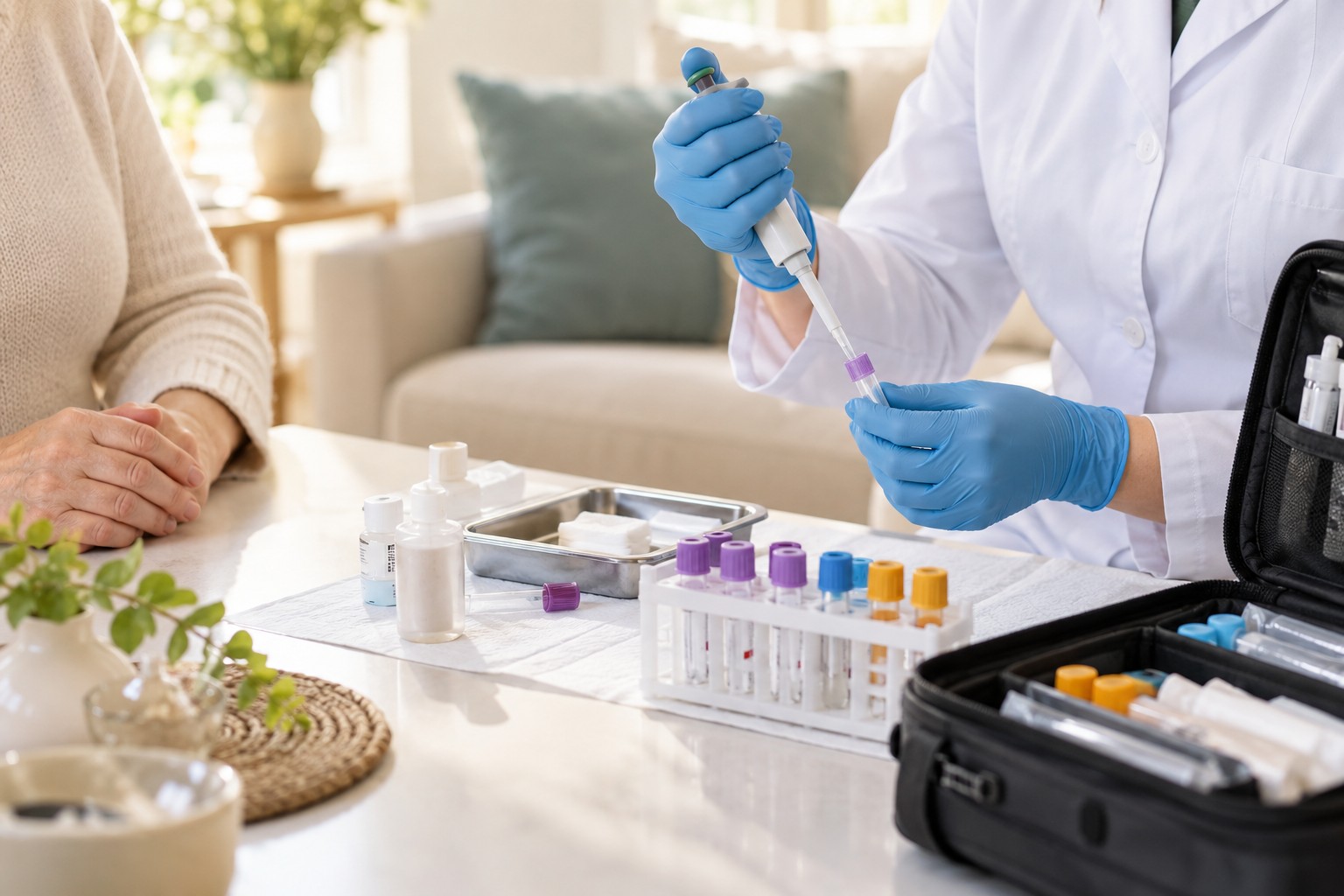
Our nurse comes to your address and collects your blood sample using sterile, single-use supplies.
-
03
You receive your result
Your sample is transported to the laboratory under appropriate conditions; your result is sent to you when it is ready.
Frequently asked questions
The information on this page is for general information only; it does not replace diagnosis or treatment. Consult your doctor for decisions about your health.